Blog

  • Remote Monitoring and Alarms: Why Real-Time Alerts Matter in Stability Testing

    Remote Monitoring and Alarms: Why Real-Time Alerts Matter in Stability Testing

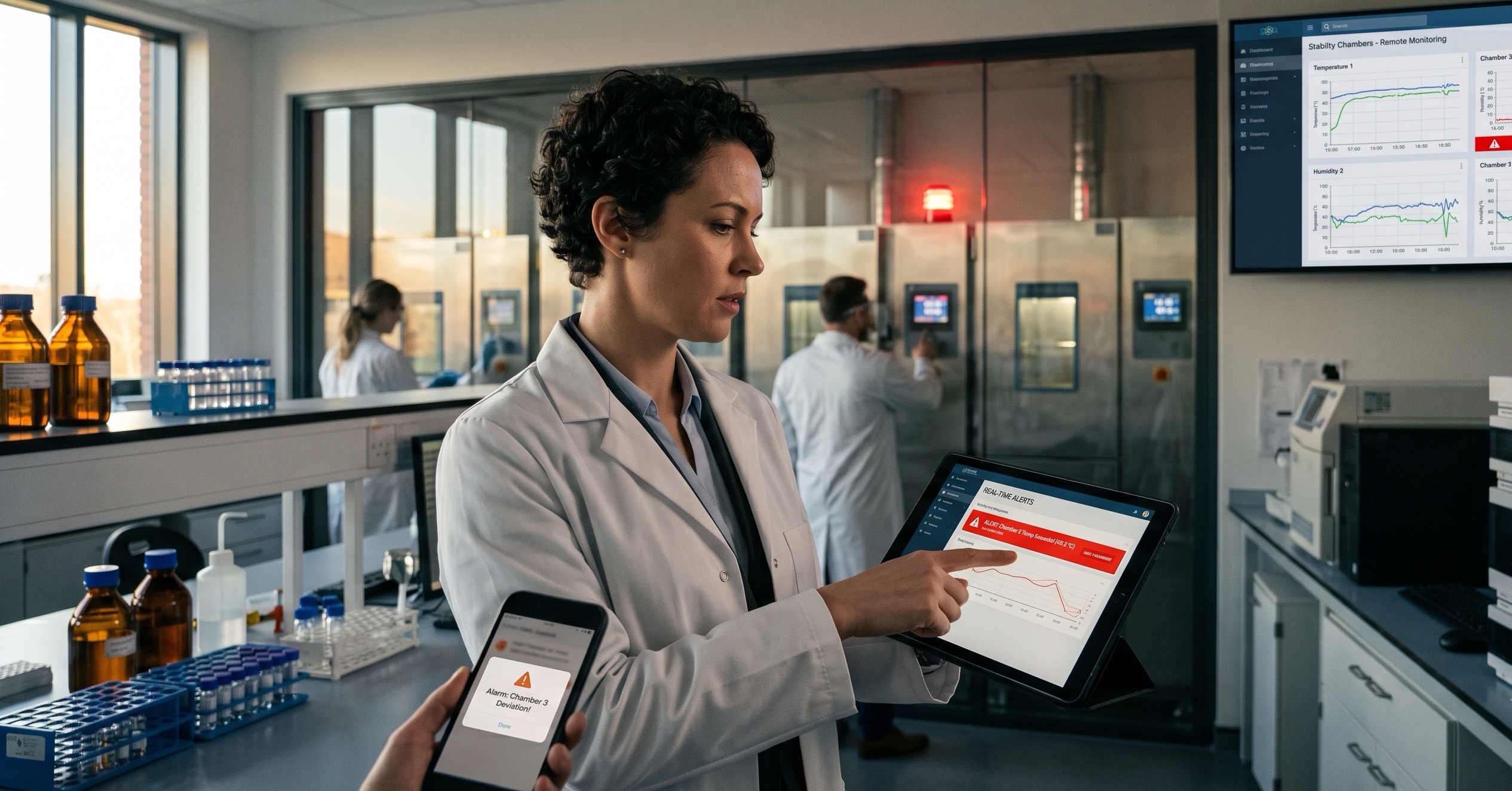
    A stability study can take months or years to complete, and the integrity of that entire dataset rests on uninterrupted, controlled storage conditions. A temperature excursion lasting just a few hours can invalidate months of work, compromise product quality, and trigger costly regulatory investigations. Remote monitoring and real-time alarm systems are the last line of defence between a recoverable incident and a catastrophic data loss event.

    The Risk Landscape in Stability Storage

    Stability chambers operate continuously, nights, weekends, and public holidays included. Equipment failures, power outages, refrigerant leaks, door seal failures, and sensor faults can all cause environmental deviations. Without active monitoring, these events may go undetected for hours.

    In a GMP environment, every excursion must be documented and investigated. Repeated or prolonged excursions can call into question the validity of stored samples and may require a study to be restarted, a significant cost in both time and resources.

    What Is Remote Monitoring for Stability Chambers?

    Remote monitoring systems continuously track temperature, humidity, COโ‚‚ (where applicable), and equipment status from stability chambers, cold rooms, incubators, and freezers. Data is transmitted in real time to a central platform โ€” accessible via web browser or mobile app, where it is logged, trended, and compared against user-defined alarm thresholds.

    Modern systems typically include:

    • Continuous data logging at configurable intervals (e.g., 5 minutes to 60 minutes+)
    • High and low alarm thresholds for temperature and humidity
    • Multi-channel alerting via SMS, email, and/or push notification
    • Escalation chains: primary contact โ†’ secondary contact โ†’ on-call engineer
    • Audit trail and 21 CFR Part 11 / Annex 11 compliant data storage
    • Dashboard views for multiple chambers across multiple sites

    Why Real-Time Alerts Are Non-Negotiable

    Protecting Sample Integrity

    ICH Q1A(R2) requires that stability samples be stored under precisely defined, validated conditions. Any deviation must be investigated and its impact on sample integrity assessed. Real-time alerts enable personnel to respond quickly, often within the equipment’s recovery window, minimising or eliminating the impact of an excursion.

    Regulatory Compliance

    Both FDA 21 CFR Part 211 and EU GMP Annex 15 require documented evidence that storage conditions were maintained throughout a study. A remote monitoring system with a compliant data trail provides continuous, irrefutable evidence and significantly simplifies regulatory submissions and inspections.

    Reducing Human Error

    Manual temperature log checks, even when performed diligently are periodic snapshots. A sensor reading at 8 AM and 4 PM tells you nothing about what happened at 2 AM. Automated monitoring removes the reliance on manual checks and provides a complete, unbroken data record.

    Business Continuity

    The financial cost of a failed stability batch, restocking, repeat studies, delayed submissions, or product recalls far outweighs the cost of a monitoring system. Real-time alerts allow facilities teams to respond to equipment faults outside of business hours, protecting both product and program timelines.

    Key Features to Look For

    • 21 CFR Part 11 / EU Annex 11 compliance with audit trail and electronic signatures
    • Redundant alarm delivery paths (SMS + email)
    • Configurable escalation chains with acknowledgement tracking
    • Data storage with defined backup and disaster recovery
    • Inter-site dashboard for enterprise-level visibility

    Remote Monitoring as a Validation Asset

    Beyond operational protection, a robust remote monitoring system also generates the continuous environmental data that supports PQ requalification and trend analysis. When regulators ask for evidence of ongoing performance within qualified parameters, a system with historical data export capability makes compliance straightforward.

    Real-time remote monitoring is no longer an optional add-on for pharmaceutical stability labs, it is an operational and regulatory necessity. The combination of continuous data logging, instant alarm notification, and audit-ready records protects your samples, your studies, and your regulatory standing.

    All of our stability chambers, incubators, photo stability and cold rooms are compatible with NIV-DAS, our 21 CFR Part 11 compliant remote monitoring software. Ask our team about integrated monitoring solutions for your facility.
  • ICH Q1A(R2) Stability Testing: A Complete Guide for Pharma Manufacturers

    ICH Q1A(R2) Stability Testing: A Complete Guide for Pharma Manufacturers

    Stability testing is a non-negotiable requirement for drug approval and ongoing product quality assurance. ICH Q1A(R2), the internationally harmonised guideline for stability testing of new drug substances and products, defines the conditions, timepoints, and data requirements that regulators in the US, EU, Japan, and beyond expect to see in a registration dossier. This guide gives pharmaceutical manufacturers a clear, practical understanding of what ICH Q1A (R2) requires and how to build a compliant stability program.

    What Is ICH Q1A(R2)?

    ICH Q1A(R2) is a guideline developed by the International Council for Harmonisation of Technical Requirements for Pharmaceuticals for Human Use. It specifies the data package needed to establish a shelf life for new chemical entities (NCEs) and their drug products. The ‘(R2)’ designation indicates it is the second revision, which has been in effect since 2003.

    The guideline applies to both new drug substances (APIs) and new drug products (finished dosage forms), including tablets, capsules, liquids, injectables, and more.

    The Four ICH Climate Zones

    ICH divides the world into four climatic zones, each representing a different environmental stress condition. Your target market determines which zone conditions you must test under.

    • Zone I โ€“ Temperate: 21ยฐC / 45% RH (e.g., UK, Northern Europe)
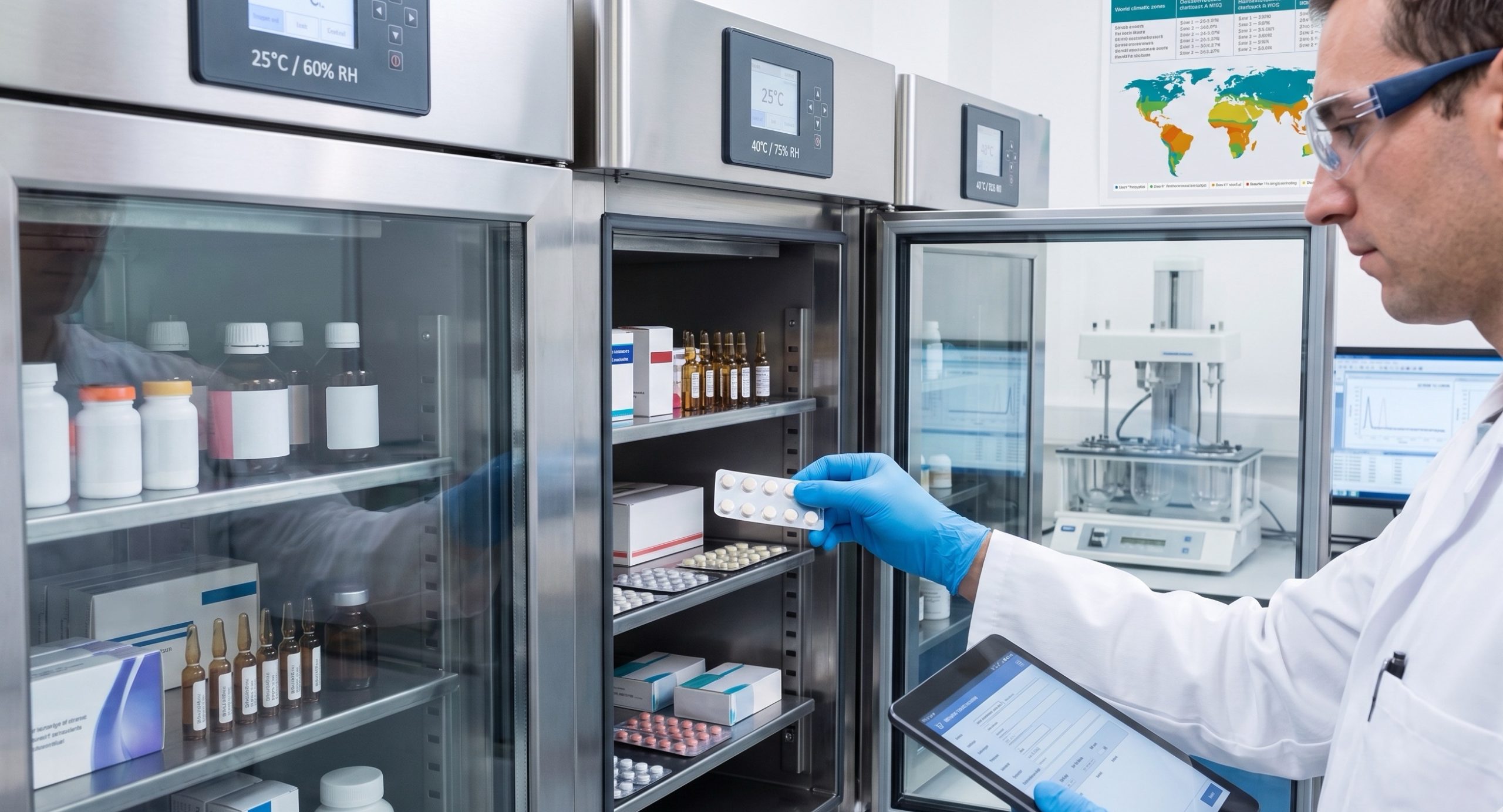
    • Zone II โ€“ Subtropical/Mediterranean: 25ยฐC / 60% RH (e.g., USA, Japan, EU)
    • Zone III โ€“ Hot and Dry: 30ยฐC / 35% RH (e.g., Middle East)
    • Zone IVa โ€“ Hot and Humid: 30ยฐC / 65% RH (e.g., Brazil, parts of Asia)
    • Zone IVb โ€“ Hot and Very Humid: 30ยฐC / 75% RH (e.g., India, Southeast Asia, sub-Saharan Africa)

    Most global registration dossiers require data at Zone II conditions (25ยฐC/60% RH) at minimum. Applications targeting markets in Zone IVb must include data at 30ยฐC/75% RH.

    Required Testing Conditions

    Long-Term Testing

    Long-term studies are conducted under conditions representing the intended storage environment. For Zone II, the standard long-term condition is 25ยฐC ยฑ 2ยฐC / 60% ยฑ 5% RH. Data is generated at 0, 3, 6, 9, 12, 18, and 24 months, then annually through the proposed shelf life.

    Accelerated Testing

    Accelerated studies use elevated conditions, typically 40ยฐC ยฑ 2ยฐC / 75% ยฑ 5% RH to predict shelf life and identify potential degradation pathways faster. Accelerated testing is typically run for 6 months with testing at 0, 3, and 6 months.

    Intermediate Testing

    Intermediate testing at 30ยฐC ยฑ 2ยฐC / 65% ยฑ 5% RH is triggered when a product shows significant change at accelerated conditions. It bridges the gap between accelerated and long-term data and is required in some regulatory submissions.

    Important: Significant change at accelerated conditions triggers mandatory intermediate testing and may require reassessment of the proposed shelf life.

    What Constitutes ‘Significant Change’?

    ICH Q1A(R2) defines significant change for drug products as any of the following:

    • A 5% loss in potency from initial assay value
    • Any degradation product exceeding its acceptance criterion
    • Failure to meet acceptance criteria for appearance, physical attributes, or functionality tests
    • pH falling outside acceptable limits (for liquid dosage forms)
    • Dissolution failure for 12 of 12 units tested

    Storage Conditions for Drug Substances

    For new drug substances, ICH Q1A(R2) requires the same long-term, accelerated, and intermediate conditions as drug products. Additionally, stress testing including thermal degradation, humidity exposure, is required to characterise inherent stability and degradation pathways.

    Packaging Considerations

    Stability studies must be conducted in the proposed commercial packaging or a simulated representative pack. Container closure integrity is critical, semi-permeable containers (e.g., LDPE bottles, PVC blisters) require specific testing provisions under the guideline.

    Data Evaluation and Shelf-Life Estimation

    Shelf life is determined by statistical analysis of degradation data over time. ICH Q1E (Evaluation of Stability Data) provides the statistical methodology, including regression analysis with 95% one-sided confidence intervals. The proposed shelf life cannot exceed the period covered by available long-term data at the time of submission without adequate justification.

    Equipment Requirements for ICH Q1A(R2) Compliance

    Stability chambers used for ICH-compliant studies must be capable of maintaining precise temperature and humidity setpoints with validated uniformity across the full chamber volume. Key requirements include:

    • Temperature accuracy: ยฑ2ยฐC of setpoint throughout the chamber
    • Humidity accuracy: ยฑ5% RH of setpoint
    • Continuous data logging with time-stamped, audit-trail-capable records
    • Validated alarm systems for out-of-specification (OOS) deviations
    • IQ/OQ/PQ documentation and periodic requalification

    ICH Q1A(R2) compliance is foundational to drug approval and product lifecycle management. Understanding the required conditions, timepoints, and data expectations allows you to design a stability program that supports global registration from the outset. Investing in properly validated stability chambers and robust data management systems is not just a regulatory requirement, it is a business-critical quality investment.

    Our range of ICH-compliant stability chambers is designed to meet the precise environmental requirements of Q1A(R2) studies, with built-in data logging and alarm systems ready for your validation process.

  • Walk-In vs. Reach-In Stability Chambers: Which Is Right for Your Lab?

    Walk-In vs. Reach-In Stability Chambers: Which Is Right for Your Lab?

    3โ€“4 minutes

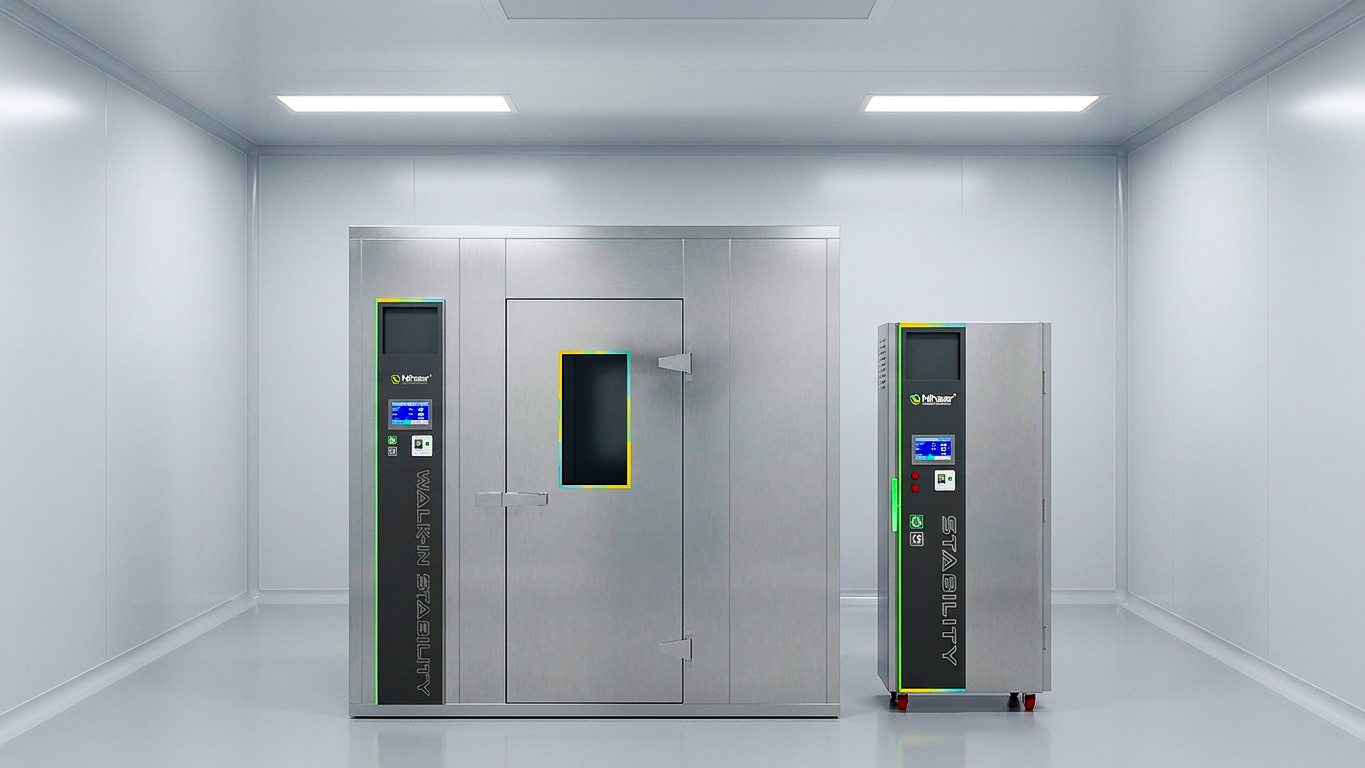
    Choosing between a walk-in and a reach-in stability chamber is one of the most consequential procurement decisions a pharmaceutical or biotech lab can make. The right choice depends on your sample volumes, available floor space, budget, regulatory requirements, and long-term growth plans. This guide breaks down the key differences so you can make a confident, informed decision.

    What Are Stability Chambers?

    Stability chambers are precision-controlled environments used to store pharmaceutical products, APIs, finished dosage forms, and biological samples under defined temperature and humidity conditions. They are central to ICH-compliant stability studies and quality control workflows across pharma, biotech, and R&D.


    Reach-In Stability Chambers: An Overview

    Reach-in chambers are freestanding, cabinet-style units typically ranging from 200 to 2,000 litres in capacity. They are designed for floor placement within a laboratory setting.

    Key Advantages

    • Compact footprint โ€” ideal for labs with limited floor space
    • Lower upfront capital investment
    • Faster installation and qualification (IQ/OQ/PQ)
    • Easier to relocate if your lab layout changes
    • Available in a wide range of ICH climate zone configurations (Zone Iโ€“IVb)

    Limitations

    • Limited storage capacity โ€” not suited for large-scale studies
    • Door opening disrupts internal conditions more significantly
    • Multiple units needed for high-volume programs, increasing maintenance overhead

    Walk-In Stability Chambers: An Overview

    Walk-in chambers are large, room-sized enclosures, often custom-built and ranging from a few cubic metres to several hundred square metres. They are engineered for high-volume storage and continuous access.

    Key Advantages

    • Massive storage capacity, accommodates thousands of samples simultaneously
    • Supports multiple simultaneous stability programs and time-points
    • Personnel can enter and retrieve samples without significantly disrupting conditions
    • More cost-effective per-sample at scale
    • Better suited for GMP manufacturing environments

    Limitations

    • Significant capital expenditure and construction lead times
    • Requires dedicated floor space and structural/utility planning
    • Longer qualification and validation timelines
    • Higher energy consumption


    Side-by-Side Comparison

    Here is a quick-reference comparison of the two options across the most critical decision factors:

    CategoryReach-In ChamberWalk-In Chamber
    Capacity200L to 2,000L5,000L to 3,00,000L+
    Capital CostLowerHigher
    Installation TimeInstant1-10 Days
    Qualification EffortModerateModerate to High
    Sample ThroughputLow to MediumHigh to Very High
    Space RequirementMinimalDedicated Area

    Regulatory Considerations

    Both walk-in and reach-in chambers must meet the same core regulatory requirements, ICH Q1A(R2) for storage conditions, USP 1 for temperature mapping, and 21 CFR Part 11 if electronic records are involved. However, walk-in chambers typically require more rigorous spatial temperature and humidity mapping due to their larger volume and potential for greater gradient variation.

    When selecting either type, ensure the unit supports data logging, alarm systems, and audit trails compatible with your quality management system (QMS).


    Questions to Ask Before You Buy

    • How many samples and stability programs will I be running in 1โ€“3 years?
    • Do I have the floor space and utility infrastructure for a walk-in?
    • What is my validation budget and timeline?
    • Am I in early R&D or commercial manufacturing?
    • Do I need 24/7 remote monitoring and alarm integration?


    There is no universally ‘better’ option, the right chamber depends on your specific operational context. Reach-in units offer agility and affordability for smaller programs; walk-in chambers deliver the scale and throughput needed for commercial operations. Many growing pharma organisations start with reach-in units and transition to walk-in infrastructure as they scale.

    Need help assessing your specific requirements? Our team of stability specialists can guide you through the selection, configuration, and validation process from day one.

    To understand the type of chamber is right for you, contact us and our team will help you make the right choice.

  • Data Integrity in Pharmaceutical Manufacturing: Why It Matters More Than Ever

    In the world of pharmaceutical manufacturing, data isnโ€™t just numbers on a screenโ€”itโ€™s the backbone of product quality, patient safety, and regulatory trust. As global scrutiny intensifies and Indian pharma companies continue expanding into regulated markets, maintaining robust data integrity has shifted from a โ€œbest practiceโ€ to an absolute necessity.

    So, what makes data integrity such a critical topic today? Letโ€™s explore.

    The Foundation: What is Data Integrity?

    At its core, data integrity refers to ensuring that information remains complete, consistent, and accurate throughout its entire lifecycle. In pharmaceutical manufacturing, this spans a wide range of records, including stability study data, batch manufacturing records (BMR), calibration logs, validation reports, environmental monitoring data, and audit trails.

    Regulators expect companies to adhere to the ALCOA+ principles, ensuring data is:

    • Attributable
    • Legible
    • Contemporaneous
    • Original
    • Accurate

    And beyond thatโ€”Complete, Consistent, Enduring, and Available.

    These principles arenโ€™t just guidelines; they are the foundation of trustworthy pharmaceutical operations.

    Rising Regulatory Pressure

    Global regulatory authorities are paying closer attention than ever before. Organizations like the USFDA, EMA, and Indiaโ€™s CDSCO have tightened their expectations around data governance.

    For companies exporting to the United States, compliance with 21 CFR Part 11โ€”which governs electronic records and signaturesโ€”is especially critical.

    Failing to meet these standards can have serious consequences:

    • Warning letters
    • Import alerts
    • Product recalls
    • Even loss of market authorization

    In short, weak data integrity can shut doors to entire markets.

    Why It Matters Most in Stability Testing

    Among all areas in pharmaceutical manufacturing, stability testing stands out as particularly sensitive. These studies generate long-term data that directly supports a productโ€™s shelf life and regulatory approvals.

    Imagine if temperature or humidity data is inaccurateโ€”or worse, manipulated. The entire study becomes unreliable, potentially invalidating months or years of work.

    Thatโ€™s why modern facilities are adopting advanced systems such as:

    • PLC-based control systems
    • 21 CFR Part 11โ€“compliant software
    • Biometric access and user controls
    • Automated audit trails and e-signatures
    • Secure data backups

    These technologies donโ€™t just store dataโ€”they protect its integrity and make it audit-ready at all times.

    Building a Strong Data Integrity Framework

    Ensuring data integrity isnโ€™t a one-time effortโ€”it requires a systematic, organization-wide approach. Leading pharmaceutical companies are focusing on:

    • Implementing validated electronic data capture systems
    • Restricting access through role-based permissions
    • Maintaining detailed audit trails for critical activities
    • Conducting regular internal audits
    • Continuously training employees
    • Investing in secure, connected stability chambers

    A proactive strategy not only reduces compliance risks but also builds long-term operational resilience.

    More Than Compliance: A Strategic Advantage

    While regulatory compliance is the primary driver, strong data integrity practices offer far-reaching benefits:

    • Faster regulatory approvals
    • Better audit preparedness
    • Reduced human error
    • Increased global credibility
    • Stronger brand reputation

    In an increasingly competitive global market, these advantages can set a company apart.

    Final Thoughts

    Data integrity is no longer just a regulatory checkboxโ€”itโ€™s a business imperative. As expectations continue to rise, pharmaceutical manufacturers must invest in systems and practices that ensure data remains secure, reliable, and transparent.

    Because in the end, maintaining data integrity isnโ€™t just about complianceโ€”itโ€™s about protecting patients, earning regulatory trust, and securing the future of your business.